

In the heart of Edmonton lie two cemeteries that are now recognized as vital cultural and memorial spaces within the city. They offer a unique atmosphere of peace and quiet. The antique Gothic headstones give the grounds a distinctive look, unmatched in today’s urban landscape. Strolling among the monuments is like reading pages from the past. You can learn more about Edmonton’s early residents and founders who made significant contributions to the city’s development and now rest in this soil. Read more about the history and features of Edmonton’s cemeteries at edmonton-future.com.
The Origins of Edmonton’s First Cemeteries
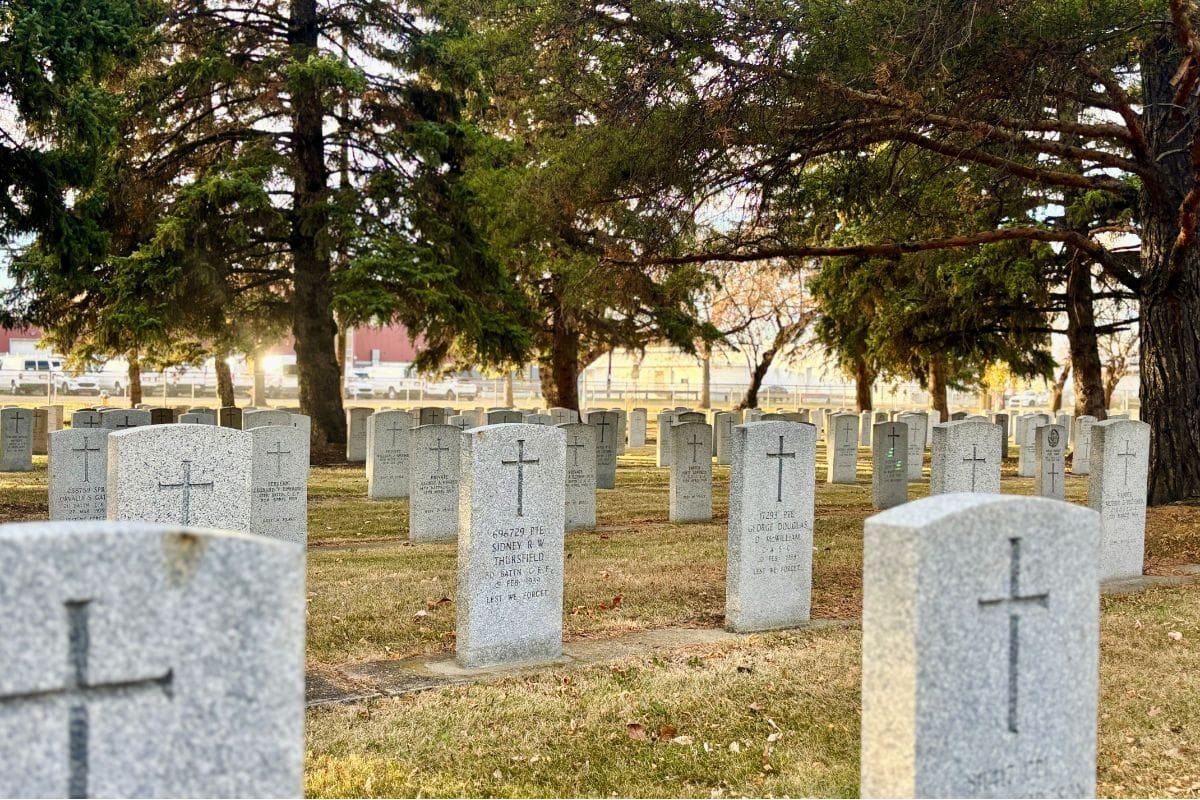
The history of the Edmonton Municipal Cemetery (Edmonton Cemetery) dates back to 1886. Previously, the city had three older graveyards: one at the Methodist mission and two at Fort Edmonton in the river valley. However, overcrowding and chaotic layouts created the need for a new, official non-denominational cemetery. The vision was a park-like setting on the outskirts of town with uniform, uncrowded plots. Pioneers like Frank Oliver, John McDougall, John Cameron, and others teamed up to form the Edmonton Cemetery Company. For this purpose, about 2.5 acres of land were allocated from the Hudson’s Bay Company reserve.
The St. Joachim Roman Catholic Mission faced similar challenges. Two years after the Edmonton Cemetery Company was founded, prominent pioneer Malcolm Groat donated about 3.5 acres of land to establish a Catholic cemetery (St. Joachim’s Cemetery). Located immediately east of the non-denominational site, this new graveyard consolidated several scattered burial grounds previously used by the mission. Its creation also meant Edmonton’s Catholics no longer had to travel to St. Albert for an official burial.
Over the next century, as Edmonton expanded, so did its two cemeteries. The Edmonton Cemetery Company later extended its grounds north of what is now 107th Avenue, while the Catholic cemetery stretched south to 105th Avenue. In 1964, the city took control of the non-denominational cemetery following stricter provincial laws governing private graveyards. However, the adjacent St. Joachim’s Cemetery remains under the management of the Catholic Church.
Edmonton’s two cemeteries are unique because, unlike many others, there is virtually no clear physical boundary between them. Across the combined grounds, there are no headstones, wrought-iron fences, or brick walls explicitly separating the Catholics from their non-denominational neighbours.
Cathedral of Memories: A Unique Mausoleum and Its Architecture
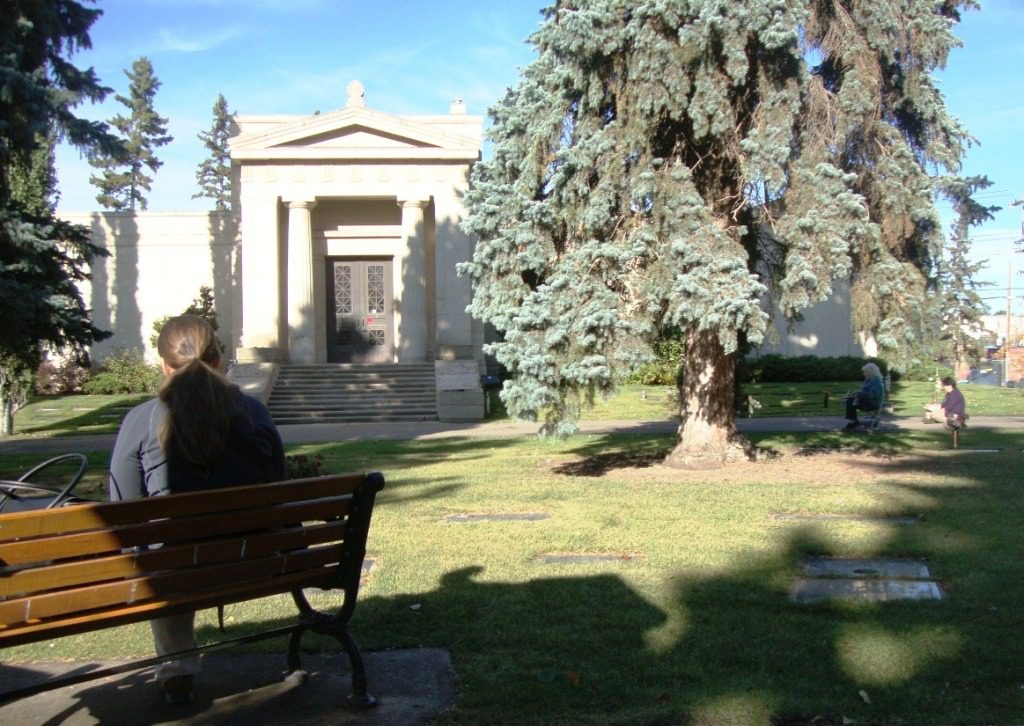
The grounds of the Edmonton and St. Joachim’s Cemeteries are home to numerous unique architectural masterpieces. One of these is the Cathedral of Memories. Its story began in the winter of 1929 when Canadian Mausoleums Limited of Toronto approached the Edmonton Cemetery Company about building a mausoleum on their site. Both parties saw this as a perfect idea. Similar facilities had existed out East for generations. Furthermore, temporary seasonal burials made logical sense for a city where the ground freezes for half the year, making winter grave-digging extremely difficult. While most Edmontonians supported the idea, there was some pushback. Fierce opponents of the project had three main concerns. First, traditionalists viewed the concept of the “unburied” deceased as relatively alien to Edmonton. Second, hygiene issues regarding the “unburied” were raised. Finally, the project’s main driving force was a private firm.
A special city council meeting was held to address these concerns. One attendee, R. Dykes from Alberta Granite, Marble & Stone, clearly stated his side’s position. He asked the Department of Health to determine whether the future mausoleum would pose a public health risk. He also pointed out that, if built, it should be subject to appropriate taxes as a commercial enterprise. At the same time, malicious flyers were distributed to undermine public confidence in the mausoleum’s durability and ongoing maintenance.
Despite the opposition, the city approved the project on July 14, 1930, and the groundbreaking took place the very next day. By November, work on the lower crypt had progressed enough to allow for temporary seasonal interments. Architect William Ralston, working with Canadian Mausoleums Ltd., was put in charge of the magnificent Greco-Doric temple design. As a result, the finest materials were used in its construction. The building’s clean lines and Doric columns were crafted from meticulously dressed stone. All interior finishes featured imported polished marble, while the hardware, doors, and fixtures were made of solid bronze. Large stained-glass windows, created by J. Bromfield, allowed natural light to flood the interior. Unfortunately, the economic downturn during the Great Depression prevented a more ambitious project from being realized.
Completed in 1933, the Edmonton Cathedral became one of the first mausoleums of its kind in Western Canada. Perhaps partly because of the new options it offered, or perhaps due to shifting attitudes toward burials, more and more citizens began requesting permanent interments there. Today, several of Edmonton’s most prominent figures rest within its walls:
- Emily Murphy – a suffragist of the “Famous Five,” author, and eugenicist.
- John Percy Page – teacher and coach of the Edmonton Commercial Graduates basketball team.
- Norman Terwillegar – pioneering surgeon and landowner.
Edmonton authorities recognize that the temple is one of the city’s sacred architectural landmarks. A complete restoration of the building was carried out in 2002.
The Field of Honour and the Cross of Sacrifice: Remembering the First World War
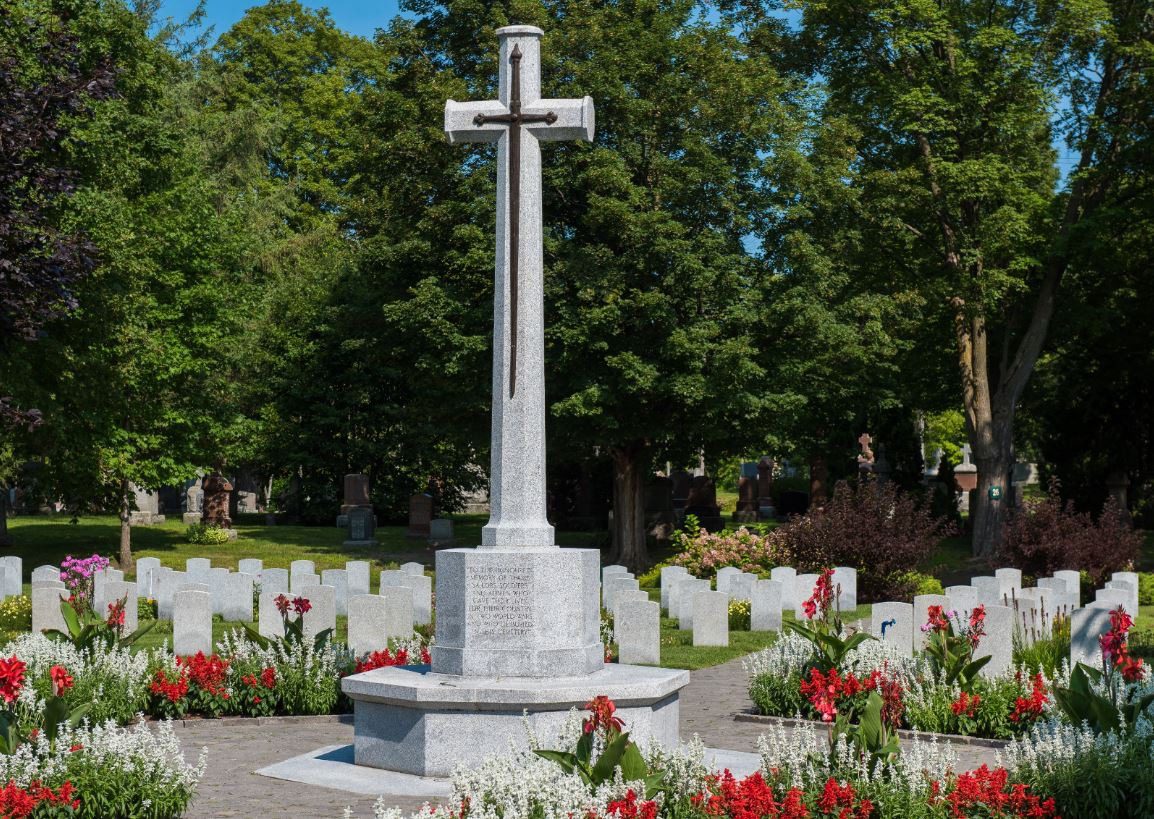
The Edmonton and St. Joachim’s Cemeteries host two more iconic monuments: the Field of Honour and the Cross of Sacrifice. By 1921, memories of the First World War were still painfully fresh. Over 600,000 Canadians had served in the military, meaning almost every family had someone who went to the front. This was even more pronounced in Edmonton. Out of a population of 72,000 in 1914, 15,764 people enlisted. Sadly, 2,365 of them never returned home. This sacrifice was heavy, and as memorial projects began taking shape across Alberta, Edmontonians sought a location for a monument. Fortunately, the Imperial War Graves Commission approached the Edmonton Cemetery Company with a proposal to create a Field of Honour. The plan involved exhuming the bodies of fallen soldiers from other cemeteries and consolidating them into a single plot at the Edmonton Cemetery. Meanwhile, a Cross of Sacrifice would be erected in memory of those who died and were buried overseas. Large-scale work began in 1921. The cemetery plot was perfectly levelled. On September 11, 1922, the monument was officially unveiled.
For the next 30 years, during Armistice Day ceremonies, the Cross of Sacrifice effectively served as the city’s cenotaph. Its role was only replaced after the official municipal monument was completed in August 1936. Together, the Cross of Sacrifice and the Field of Honour stand as some of the most significant First World War memorial projects ever completed in Alberta.