

The Walterdale Bridge is one of Edmonton’s most recognizable and architecturally striking landmarks. It doesn’t just shape the city’s skyline; it plays a crucial role in the transportation network, connecting neighbourhoods across the North Saskatchewan River. Read more about its history and design on our website, edmonton-future.com.
Demolition and Archaeological Discoveries
The old Walterdale Bridge was more than just a roadway; it was a true historical symbol of Edmonton. Serving the city for over a century, it was a classic steel bridge featuring a steel-grate deck. As cars drove over it, their tires created a signature humming sound, and you could actually see the river rushing directly beneath the grating.
The Dominion Bridge Company built the original Walterdale in 1913. Its construction was driven by the need for better transportation links following the amalgamation of Edmonton and Strathcona in 1912. Until 1967, it was officially known as the 105 Street Bridge, before being renamed in honour of John Walter. By early 2010, the old bridge was in critical condition. Its steel structures had severely rusted due to road salt and moisture. Furthermore, it could no longer support heavy trucks, meaning only passenger vehicles and light buses were permitted to cross. The two traffic lanes were far too narrow for modern vehicles, and the sidewalks simply couldn’t handle the volume of pedestrian traffic.
The old Walterdale Bridge was demolished in 2017 in what became one of the most complex engineering operations in the city’s history. This wasn’t just a simple takedown. Crews had to carefully remove a century-old, multi-ton structure suspended directly over the river. Before the heavy lifting began, the bridge was lightened as much as possible. Workers stripped away everything that wasn’t part of the load-bearing steel frame:
- The road deck.
- The wooden pedestrian sidewalks.
- Utility lines.
Heavy-duty crawler cranes were brought in for the demolition. The primary task involved lifting out entire bridge spans. The old bridge consisted of three main sections, each 70 metres long. The cranes had to perfectly balance these massive structures to prevent them from tilting and damaging either the shore supports or the brand-new bridge standing just metres away. Many locals had hoped that at least one section would be preserved as a monument, but engineering inspections deemed the steel too degraded. Most of the steel trusses were cut up on-site and sent for recycling. The city only kept small pieces of the structure, which were later repurposed into informational panels and memorials in the river valley parks. The demolition wrapped up by the end of 2017. Today, observation decks sit where the old abutments once stood on the riverbanks, giving visitors a sense of the sheer scale of the original structure.
Before the new bridge was built, archaeological digs beneath the old bridge’s supports uncovered over 3,900 artifacts. These ranged from animal bones and pottery shards to tools used by Indigenous peoples, who had utilized this river crossing for thousands of years before the first Europeans arrived.
The New Walterdale Bridge: Modern Architecture, Technology, and Its Transit Role in Edmonton
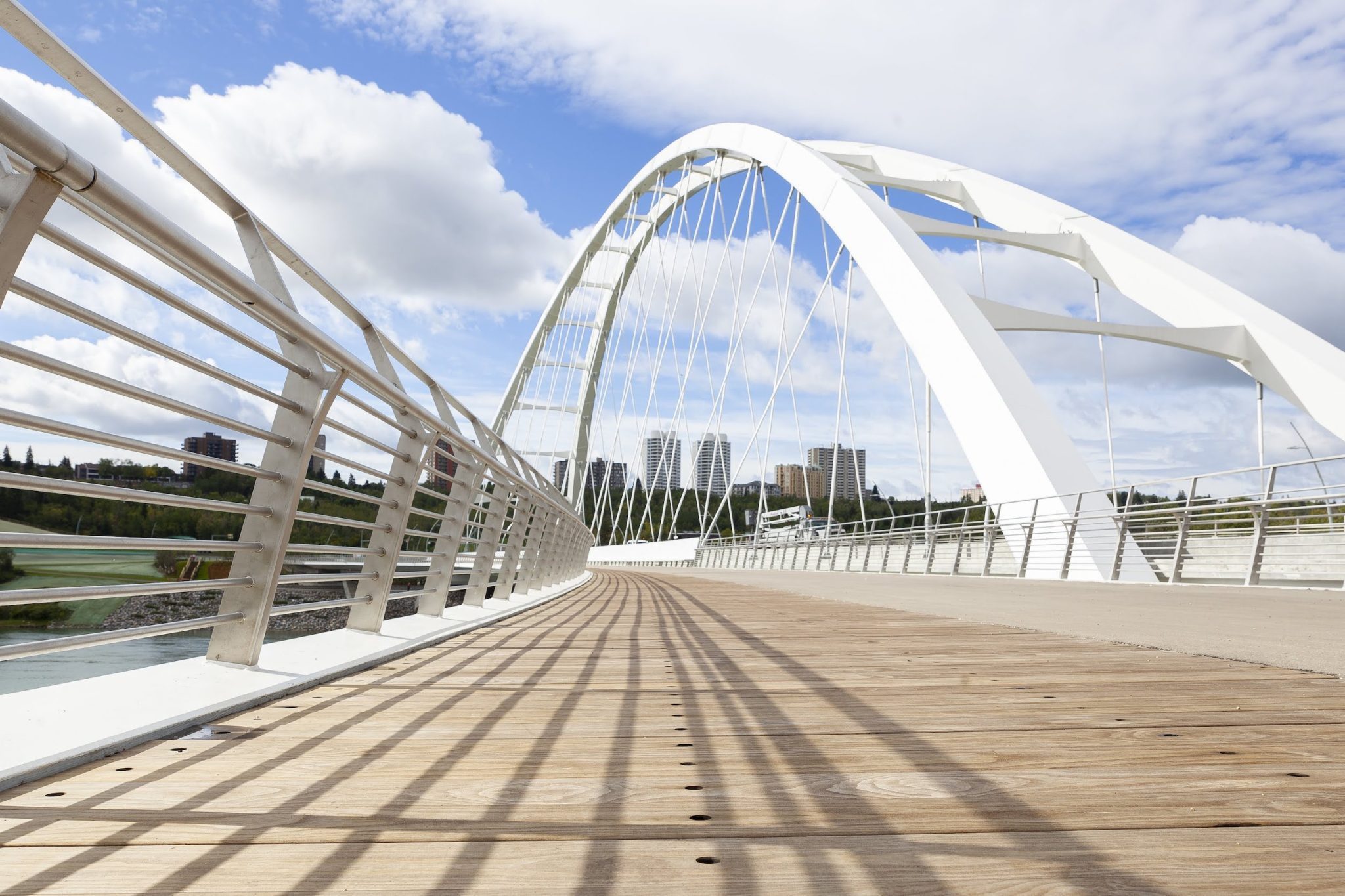
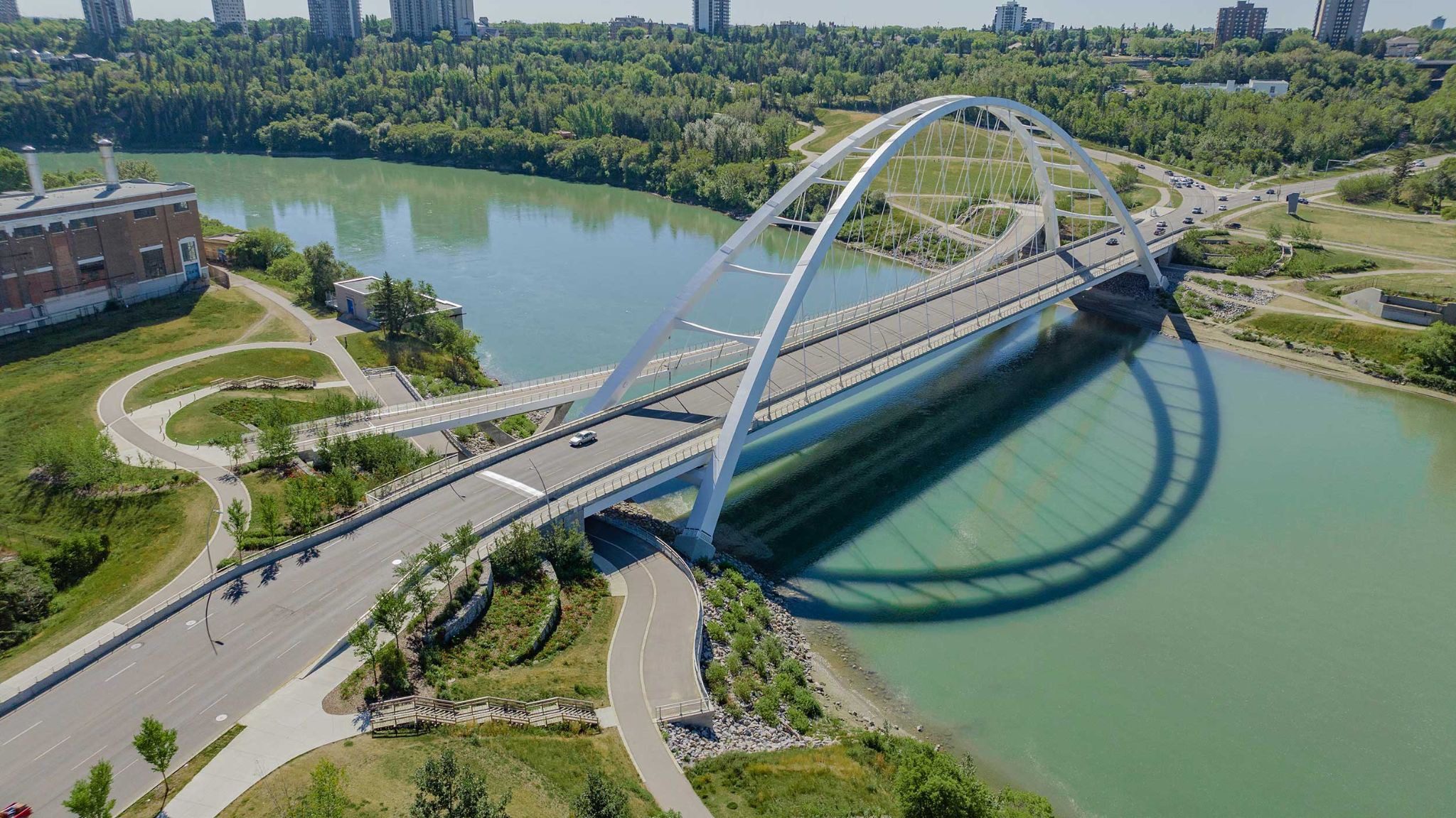
Construction on the new $155 million bridge began in 2013. The bridge features a twin steel arch design, with the arches angling inward toward the apex. Because it’s located within parkland, the city authorized the new bridge to be built right next to the old one. Engineers decided to boost its capacity by expanding from two to three northbound traffic lanes and adding a pedestrian path. The design also allows for future expansion to accommodate a fourth lane if needed.
The new Walterdale Bridge is an innovative structure featuring excellent pedestrian infrastructure, including a shared-use path on the east side and a sidewalk on the west. It’s an elegant, single-span steel structure with two through-arches stretching 206 metres—roughly the length of two football fields—from bank to bank across the North Saskatchewan River. The bridge carries three traffic lanes alongside the western sidewalk and the separate eastern shared-use path. The project also involved realigning two major roads to connect seamlessly with the bridge’s new approach layout. The result is a landmark structure that blends harmoniously into its natural surroundings while serving as a vital gateway into downtown.
The curved pedestrian and cyclist path arcs away from the vehicle traffic. It narrows in the middle and widens as it approaches both riverbanks, with timber decking welcoming users at the entrances.
Designed with a lifespan of at least 100 years, the new bridge was the most complex infrastructure project ever undertaken in Edmonton. Its arch design doesn’t just give the structure its aesthetic flair; it also eliminates the need for in-river piers, which allows ice to flow freely downstream. The bridge officially opened in 2016.