

St. Joachim Roman Catholic Church is a significant religious and architectural landmark in the Oliver neighbourhood of Edmonton. Built in 1899, this church is closely tied to the establishment of the Catholic community in the area. Its architectural beauty and historical importance make it one of the city’s most treasured sites. In this article, we explore the history, architecture, and significance of St. Joachim Church. Read more on edmonton-future.
Architecture of the Church
St. Joachim Roman Catholic Church is constructed from red brick and reflects the influence of late 19th-century French-Canadian ecclesiastical architecture. Key features of the church include its symmetrical façade, gabled roof, tall central tower, and rounded arch windows. The church’s architect, Francis H. Deggendorfer, incorporated a blend of styles that contribute to its unique character.
Traditional French-Canadian church architecture combined religious design with elements of 17th-century Baroque. By the early 19th century, Canadian architects also began integrating aspects of 18th-century British classicism. The Baroque influence in St. Joachim Church is evident in its contrasting voussoirs, grand central entrance, and oeil-de-boeuf (circular) window. Meanwhile, its arched windows, proportional balance, and symmetrical façade reflect the influence of classicism. Some elements of the church’s design also bear resemblance to Gothic architecture.
The interior of the church is adorned with Baroque-style details, including refined wooden finishes, elegant stained-glass windows, and a striking marble altar. The stained-glass windows depict St. Joachim and other saints. Additional decorative features include wooden staircases, a painted ceiling above the altar, an organ, numerous sculptures, and intricately designed doors. The church bell bears the coat of arms of Alberta’s first bishop, Vital Grandin.
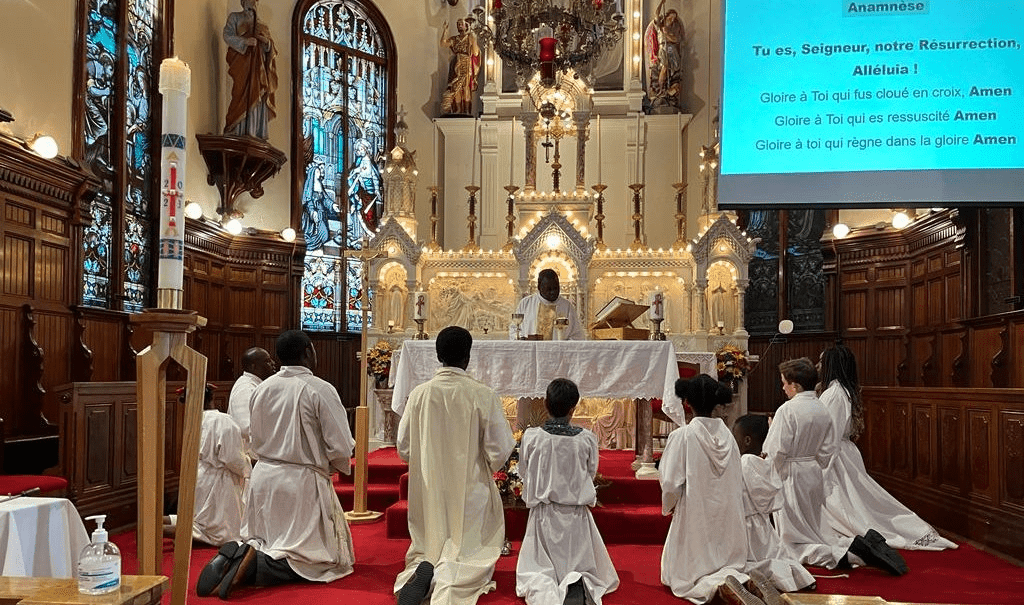
As the first Roman Catholic church in Alberta, St. Joachim Church served as a model for future Catholic churches in the province. Its impressive scale and intricate design continue to inspire admiration.
History of Construction
The origins of St. Joachim Church date back to the 1850s, when the St. Joachim mission was established in Edmonton. For many years, its members conducted services in a modest house chapel. Over time, the mission relocated twice—first to a church near what is now Stony Plain Road, and later to a small chapel near the current site of St. Joachim Church.
By the late 1890s, the growth of the mission necessitated the construction of a new church. Built in 1899, the church underwent further enhancements over the years, with elements such as the spire and stained-glass windows added later. The new church quickly became the heart of the city’s French-speaking Catholic community. Until the completion of St. Joseph’s Cathedral, St. Joachim Church also welcomed English-speaking Catholics, with liturgies conducted in both languages to serve a diverse congregation.
As Edmonton’s oldest Roman Catholic church, St. Joachim Church embodies the deep-rooted history of Catholicism in the city. Its architecture highlights the significant influence of the Catholic Church in the region.
Modern-Day Significance
St. Joachim Church remains the central place of worship for Edmonton’s French-speaking Catholic community, as well as a spiritual home for a large Francophone diaspora from Africa. For 125 years, the church has been a focal point for faith and community in Alberta, making it a landmark of profound historical and cultural importance.
In 2018, the church was designated a Municipal Historic Resource. That same year, the city’s Heritage Fund allocated over $400,000 for its restoration, ensuring the preservation of this iconic structure.
In conclusion, St. Joachim Roman Catholic Church is not only a vital religious institution but also an architectural and cultural treasure of Edmonton. More than a century after its construction, the church continues to captivate visitors with its grandeur and beauty. We hope that it will stand as a beacon of faith and history for many generations to come.