

The Kinnaird Bridge is considered the oldest in Edmonton and remains an important geographical landmark. After its construction, it was actively used by pedestrians and public transport. However, over time, it fell into neglect. Let’s explore its history and significance in more detail on edmonton-future.
Who Was George Kinnaird?
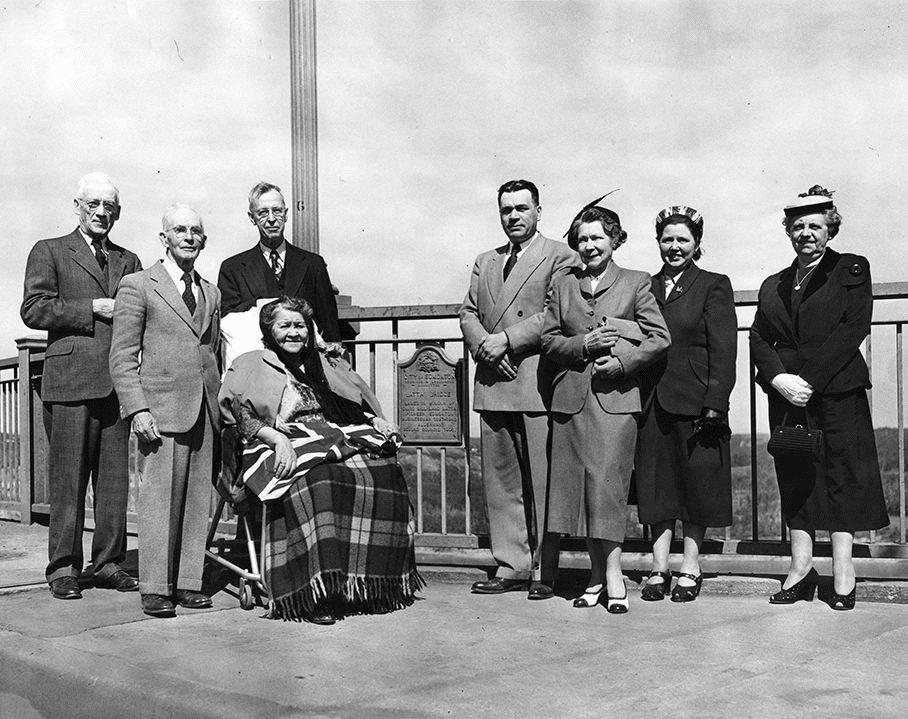
Walking along 82nd Street towards the end of Kinnaird Park at 112th and 111th Avenue, you will come across a large bridge spanning a ravine. It was named in honour of George D. Kinnaird, a Scottish immigrant to Canada. Initially, he worked as an accountant at the Hudson’s Bay Company and, in 1876, moved to Edmonton, continuing his work there. By 1891, Kinnaird was responsible for HBC’s commercial and retail operations. In 1900, he left the company to become Edmonton’s secretary-treasurer and later became the city’s first commissioner. He served in this position from 1905 to 1908 before leaving public service to start his own business. In 1911, he joined the auditing firm Kinnaird and Henderson, and by 1915, he had become Edmonton’s city auditor.
Due to his significant contributions to Edmonton’s development, both a park and a ravine were named after Kinnaird. In the early 1900s, the city acquired land near a tributary of the North Saskatchewan River—Rat Creek. By 1916, the ravine was known as Kinnaird Ravine, and in 1967, the park was officially named Kinnaird Park, stretching east from 78th Street through the ravine to the North Saskatchewan River.
The Modest Wooden Bridge
In 1909, a simple wooden bridge was built across Kinnaird Ravine along what is now 82nd Street, costing $7,000. At the time, it was a pedestrian bridge. Remarkably, some of the original wooden pillars remain to this day. City officials had always considered it a temporary solution until a larger and more durable structure could be built. In the 1920s, city planners wanted to preserve the area’s natural beauty, so the planning committee recommended against filling in the ravine for road construction.
The rising population and increased use of cars and public transit in the 1920s prompted officials to modernize all of Edmonton’s bridge structures. However, the process took a long time.
A Tragic Accident and a Difficult Decision
During the winter of 1931, concerns grew among residents and inspectors that the bridge was on the verge of collapse. The city council ordered its replacement, but discussions delayed the project. One of the main debates centred on the bridge’s design—whether to use steel or concrete. City engineers argued that steel offered flexibility, making it safer for heavy traffic. However, a concrete bridge would be more cost-effective. After lengthy deliberations, the decision was made to go with concrete.
A tragic accident may have sealed the fate of the old bridge. In 1931, the Edmonton Bulletin reported that at 1:50 AM on a Sunday, a Chevrolet coupe driven by Alex Hamilton sped 48 feet across the intersection of 111th Avenue and 82nd Street, crashed into the bridge railing, flipped backward, and plummeted 50 feet to the bottom of the Rat Creek ravine. The driver suffered an arm injury, one passenger was unharmed, and another was severely injured.
That same year, city authorities opted for a conservative bridge design using steel structures with a concrete deck and embedded tram tracks. The project was entrusted to city engineer A. Geddow. The Dominion Bridge Company won the contract, and construction began swiftly. Unionized steelworkers were assigned to oversee the project’s implementation. It is important to note that projects like the Kinnaird Bridge were financed through special legislative measures.
Construction and Grand Opening
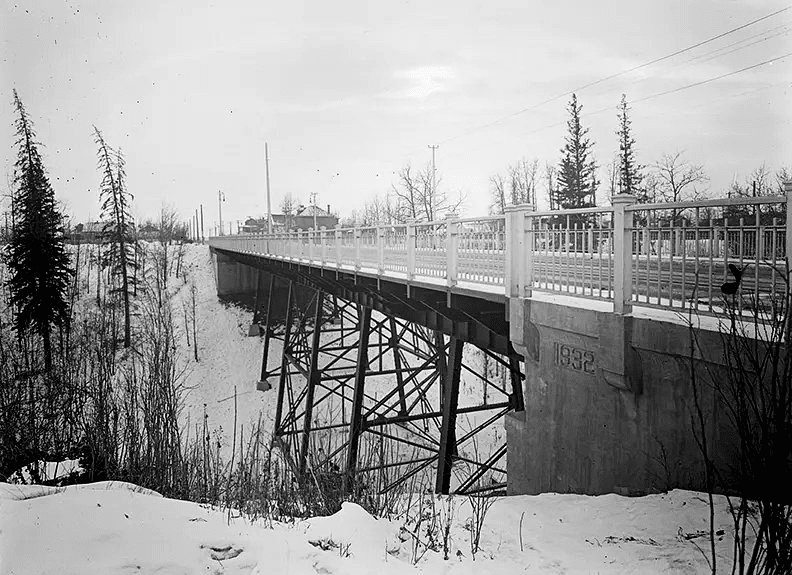
Construction commenced on December 29 with the drilling of the foundation. By January 19, the new concrete supports were completed, allowing workers to dismantle the old wooden trestle. Engineer Geddow stated that construction progressed so quickly that removing the old bridge became an urgent priority. This created issues for Edmonton’s tram network. As new tracks had to be installed on the bridge, transit routes were temporarily redirected, leading to passenger complaints about extended travel times.
The builders faced harsh working conditions, enduring frigid temperatures and strong winds while standing on exposed steel beams. Five workers were reportedly denied wages for their labour. During a city committee meeting, Mayor Daniel K. Knott stated that union workers were paid $1 per hour, while non-union workers received between 70 and 90 cents. Alderman James Findlay was outraged by this injustice. Meanwhile, city officials highlighted the bridge project as a successful part of Edmonton’s $850,000 unemployment relief program. The project’s budget was eventually exceeded, bringing the total cost to $82,000. Whether this was an attempt to cover financial mismanagement or mere speculation remains unknown. Nevertheless, the fight for unpaid wages was largely ignored by both the press and the public.
The Kinnaird Bridge officially opened on April 30, 1932, at 4:00 PM, just in time for the Edmonton Grads’ basketball game. The next day, trams resumed service along 82nd Street. By Sunday, over 10,000 residents had crossed the bridge. The structure had a simple yet elegant design, featuring tapered caps on its pillars and narrow railings. Initially, it was reportedly painted grey and later repainted green.
Full Restoration
By the 1950s, industrial and residential development had begun in the area around the bridge, though at a modest pace. Few buildings surrounded it at the time. By the 1930s, some industrial facilities, including the North West Brick and Supply Company, were present near the bridge.
As Edmonton expanded, Kinnaird Ravine became a dumping ground for small debris and construction waste. In the 1930s, sewer lines were laid beneath Rat Creek. More practical use of the area began in 1974 when a running trail, known as the Kinnaird Ravine Fitness Trail, was extended near 111th Avenue and 82nd Street.
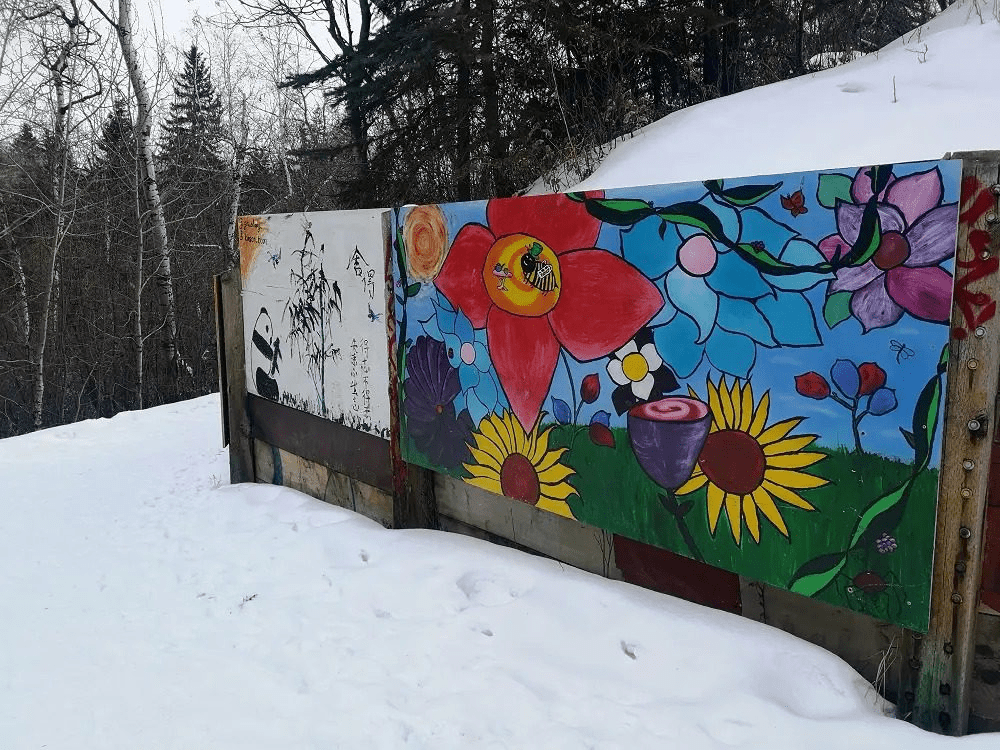
In November 2015, the large-scale KinnArt Ravine Project was launched. Sixty murals, created by local youth from various neighbourhoods, were installed on the retaining walls along the ravine’s gravel path.
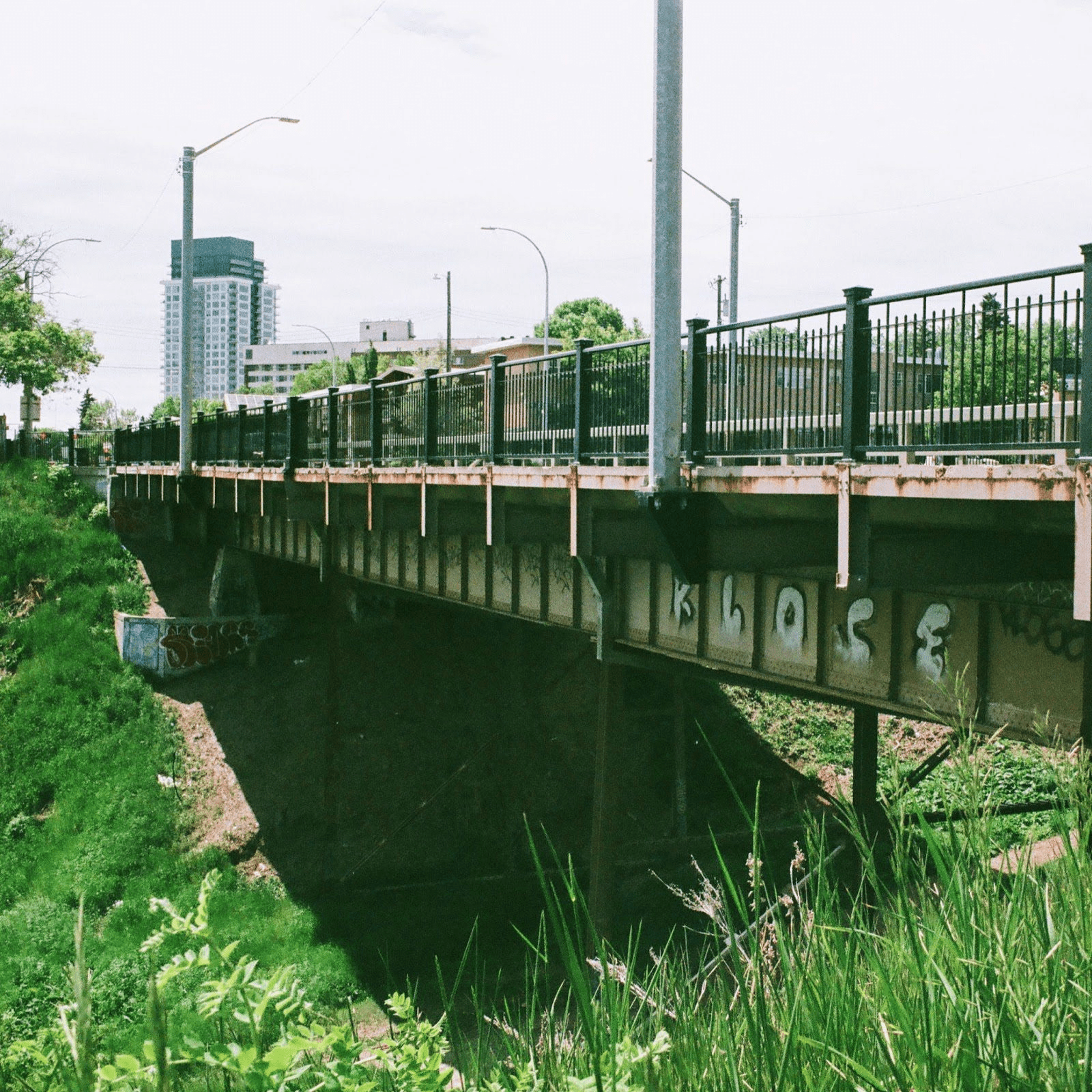
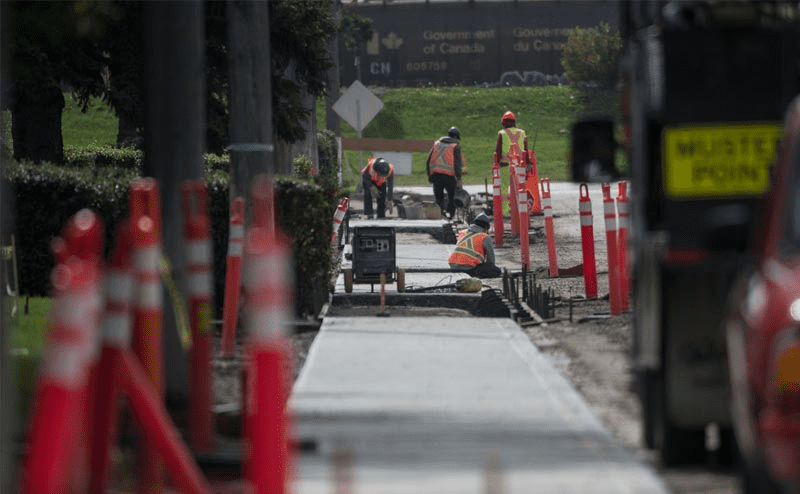
In 2022, major restoration work on the Kinnaird Bridge began, and by 2023, all renovations were completed. The extensive reconstruction included repairing and modernizing the bridge deck, sidewalks, and railings, reinforcing the support structures, repainting the lower sections, and landscaping the surrounding area by restoring trees and shrubs. Today, the Kinnaird Bridge serves as a four-lane roadway, continuing to play a crucial role in Edmonton’s transportation network.