

On September 6, 1927, representatives of the Canadian Bank of Commerce visited Edmonton as part of an international tour. They were astonished by the city’s rapid growth and, before departing, announced that Alberta’s capital would soon see the construction of a new bank building. This article explores how Edmonton became home to a stunning structure with unparalleled architecture and a fascinating history. Read more on edmonton-future.
The Origins: Purvis Block
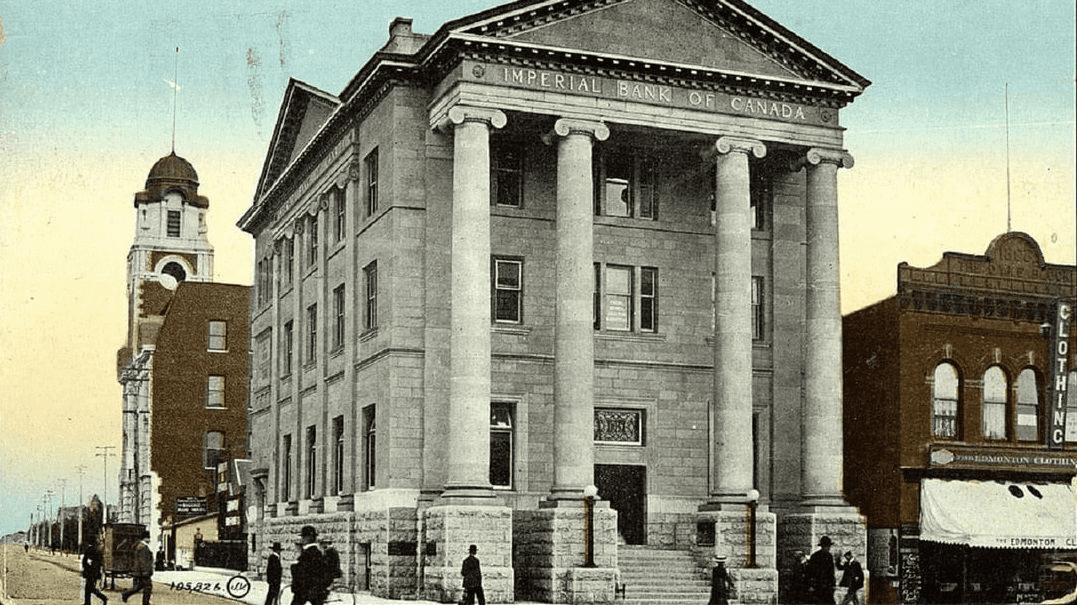
The new building was planned for the northwest corner of Jasper Avenue and 101st Street—a location chosen for strategic reasons. According to the Edmonton Journal, the land was put up for sale by Hudson’s Bay Company and was purchased by John A. McDougall, a businessman, city planner, and future mayor. His company, McDougall & Secord, Limited, had erected a brick building on the site in 1897, later known as Purvis Block. By 1927, the structure had significantly deteriorated but remained an architectural landmark of Edmonton. As a tribute to the site’s history, the Canadian Bank of Commerce promised a worthy successor.
The Construction Begins
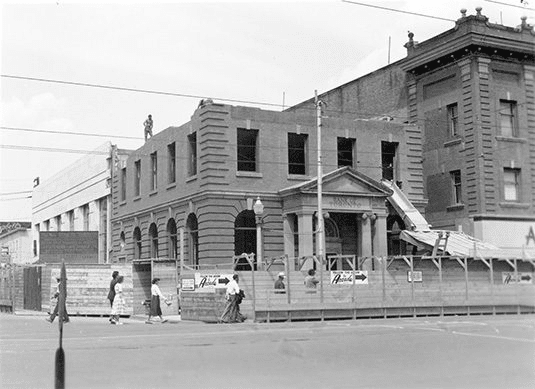
As General Manager S. Logan explained, the bank’s policy had always been to establish branches in every city. Consequently, the decision was made to construct a five-story building using brick and stone, primarily for office space, with three small retail shops on the premises. The Edmonton Bulletin predicted that this new bank building would become the largest structure on Jasper Avenue.
Before construction, the demolition of the old Purvis Block began. On April 2, 1928, contractors led by S. Mattart worked from dawn until late at night, dismantling the building brick by brick. A 15-man crew started at 5:00 AM, and at midday, another team took over, working until 10:00 PM. By May, nothing remained of the old structure. The construction contract was awarded to H.G. MacDonald Co., Edmonton’s largest developer. By late May, the city had issued a $300,000 building permit, and work commenced in June. By August, the concrete framework was in place. The official opening of the Canadian Bank of Commerce building took place on July 2, 1929.
An Architectural and Engineering Masterpiece
The Edmonton Bulletin hailed the building as the city’s finest structure and a valuable asset to Edmonton’s commercial and industrial landscape. The newspaper also suggested that the presence of such an establishment would facilitate business in the city. This was no exaggeration—Edmonton’s new bank was a marvel of architectural and engineering ingenuity.
The building featured a Dunham differential heating system, an innovation in Canada at the time. It enabled air conditioning and thermostatic control. Two high-speed passenger elevators, capable of ascending 350 feet per minute, provided efficient access to upper-floor offices. The reinforced concrete and steel framework made the structure fire-resistant.
The bank’s architectural style reflected Edwardian classicism, a hallmark of the early 20th century. According to Maitland, Hucker, and Ricketts in A Guide to Canadian Architectural Styles, such buildings adhered strictly to traditional proportions and themes while showcasing grandeur and intricate detailing. The design incorporated Tuscan columns, decorative balconies, protruding travertine elements, and copper cornices.
Another influence was Art Moderne, which gained popularity during the Great Depression. The building’s main façade followed a linear design, while the east side featured simple columns at street level. The interior was equally impressive. A spacious banking hall was beautifully decorated and furnished, complete with revolving doors, terrazzo and linoleum flooring inlaid with marble, walnut-paneled walls, and brass teller stations. Ornate Ionic columns, a coffered ceiling, and plaster moldings further enhanced the grandeur. A polished safe deposit vault wall stood as a centerpiece.
Despite the bank’s name being displayed prominently on the exterior, it only occupied the first and basement floors. The upper four floors were leased to various businesses, including London Life Insurance Company, and legal firms like Friedman & Lieberman and Parlee, Freeman & Howson.
Major Changes
In 1962, the Canadian Bank of Commerce merged with the Imperial Bank of Canada, forming the Canadian Imperial Bank of Commerce (CIBC). This merger threatened the building’s future as most operations were relocated to CIBC’s newly constructed headquarters. In 1963, as competitors built modern structures, the bank’s management debated replacing the old building. However, financial prudence prevailed, leading to a renovation instead of demolition.
By the late 1980s, another demolition threat emerged from Olympia & York, which planned a large redevelopment project for CIBC. Their CityCentre proposal included a shopping mall and two towers. Olympia & York presented renderings to the city council that depicted the CIBC building’s façade integrated into a new development. However, in 1989, revised plans no longer included this integration. To appease critics, developers proposed preserving elements of the façade inside a modern structure—a move condemned as reducing the historic building to a mere museum relic.
By 1990, the first phase of CityCentre, featuring a shopping complex and one tower, opened. However, the project had a negative impact on the commercial market. Concerned preservationists, along with the city’s new mayor, successfully campaigned to halt the second tower’s construction in 1991, saving the historic CIBC building.
Full Restoration
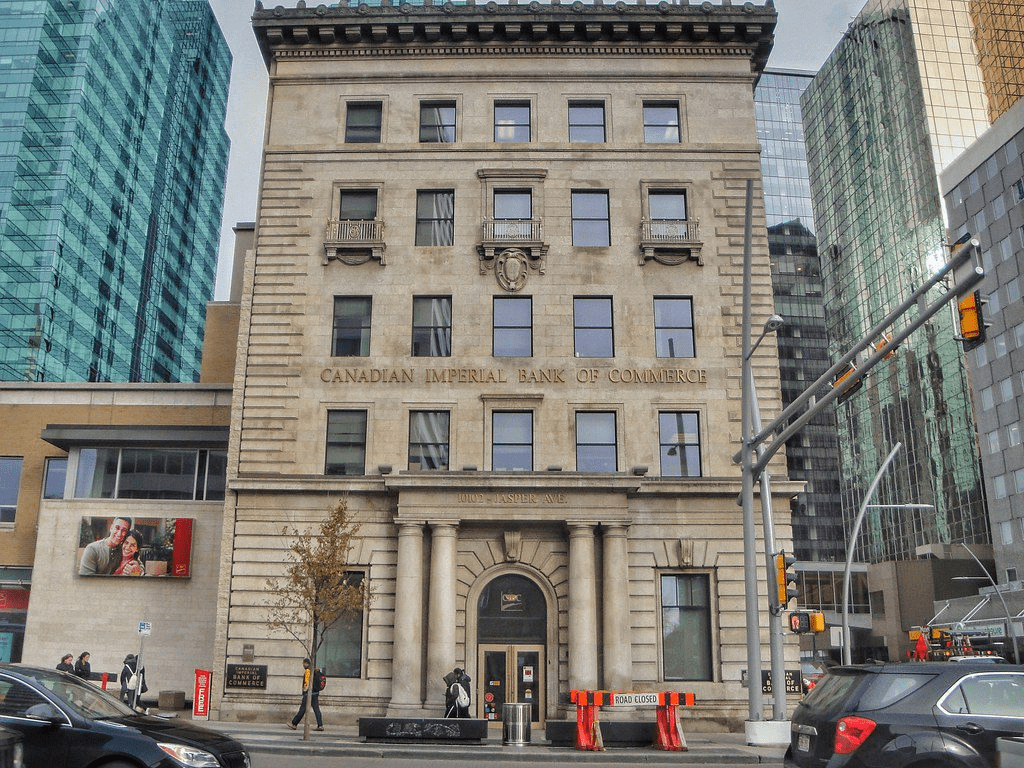
Eventually, Olympia & York declared bankruptcy, and CIBC acquired ownership of the Edmonton property from the now-defunct developer. In a twist of fate, the bank undertook a full restoration of the nearly 70-year-old structure.
Restoration crews cleaned the exterior walls and sourced bricks from the same quarry used in the original 1929 construction. Inside, historic elements such as columns, coffered ceilings, and plaster moldings were repaired and repainted. Upper floors, abandoned since 1995, were renovated for future office space. Additionally, a two-story extension linked the building to Commerce Place, which replaced CityCentre in 1993.
Remarkably, the Canadian Bank of Commerce building, standing for nearly a century, remains one of only four pre-World War II bank halls still intact in Edmonton. It is the last of its kind still serving its original purpose.